Chatbot vs. AI Assistant vs. RAG: Which Does Your Business Actually Need?

Short answer: Use a rule-based chatbot when customers ask a small set of predictable questions. Use an LLM-powered assistant when conversations are open-ended but answers don't depend on your private or fast-changing information. Use a RAG system (retrieval-augmented generation) when answers must come from your own documents or data and must be accurate and checkable, for example policies, contracts, regulations, product manuals or knowledge bases.
The three options in plain English
1. Rule-based chatbot
A decision tree with a chat interface. It recognises keywords or button choices and replies with pre-written answers.
- Good for: order status, opening hours, booking flows, FAQs with fixed answers.
- Strengths: predictable, cheap, fast to build, no risk of made-up answers.
- Weaknesses: breaks as soon as a question is phrased unexpectedly. Feels robotic.
2. LLM-powered assistant
A large language model (such as GPT or Claude) with instructions about your business. It understands free-form questions and writes natural answers.
- Good for: drafting, summarising, general guidance, triaging support tickets, internal productivity.
- Strengths: handles any phrasing, multilingual, quick to prototype.
- Weaknesses: knows only what it was trained on plus what you put in the prompt. Can state wrong things confidently ("hallucinate") when asked about specifics it doesn't have.
3. RAG system
An LLM connected to a search engine over your content. For each question it first retrieves the most relevant passages from your documents, then answers from those passages, ideally with citations.
- Good for: answering from policies, contracts, legal or regulatory texts, technical documentation, research, support knowledge bases.
- Strengths: accurate on your specifics, always current (update the documents, not the model), answers can be verified.
- Weaknesses: needs a data pipeline. Collecting, cleaning and indexing documents is real engineering work.
How to decide: four questions
- Are the questions predictable? If 90% of conversations follow a few paths, start with a rule-based bot, or a hybrid that hands off to a human.
- Do answers depend on your private information? If yes, a plain LLM assistant will guess. You need retrieval (RAG) or a direct integration with your systems.
- What does a wrong answer cost? Low cost (e.g. a marketing draft): an LLM assistant is fine. High cost (legal, financial, medical, compliance): use RAG with citations and human review.
- How often does the information change? Frequently changing information belongs in a retrieval index, not in a prompt or model training.
A real example: when only RAG would do
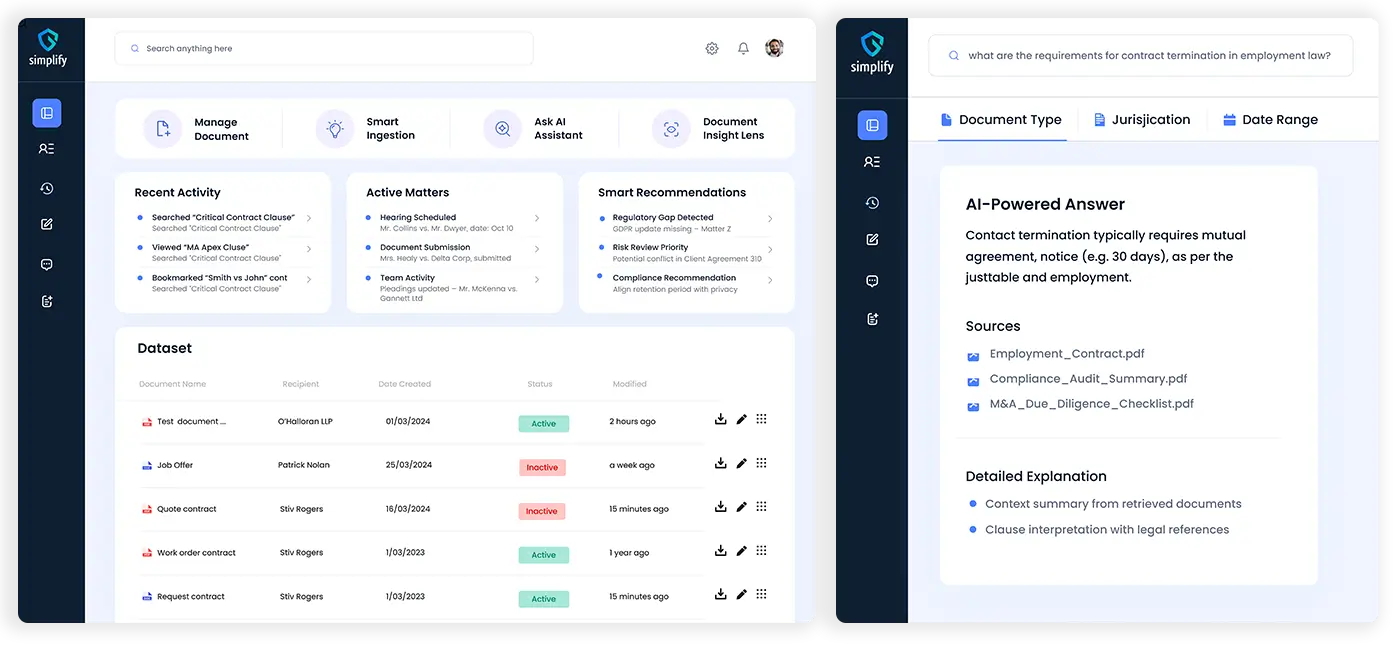
A European LegalTech startup wanted to let compliance officers and lawyers ask questions about laws across many countries. A chatbot couldn't cope with open-ended questions, and a general LLM misread legal language and couldn't cite sources.
Shrijan Tech built a RAG-based legal assistant. Scrapers collect laws from 120+ government sources, OCR digitises scanned documents, classifiers tag them across 25+ legal categories, and Elasticsearch and Pinecone provide hybrid search. A domain-tuned model, orchestrated with LangChain and OpenAI APIs, answers with citations. More than 1.2 million documents were processed within three months, and users' legal research became 80% faster. The architecture is explained in How to Build a Legal AI Assistant That Cites Its Sources.
What about AI customer support?
Most strong support assistants today are hybrids. Structured flows handle common tasks such as tracking orders, booking and resetting passwords. RAG over the help centre answers open questions. Clean handoff to a human covers anything sensitive or unresolved. We cover the customer-support side in How AI Chatbots Are Redefining Customer Support.
What does each option involve to build?
- Rule-based chatbot: conversation design, integrations with booking or order systems, testing of every path.
- LLM assistant: prompt and guardrail design, choosing a model, logging and monitoring, privacy review of what users may paste in.
- RAG system: all of the above, plus document collection, cleaning and OCR, classification and metadata, a search index (keyword plus vector), an evaluation set of real questions with known answers, and a process for keeping content fresh.
Frequently asked questions
What is the difference between a chatbot and an AI assistant?
A traditional chatbot follows pre-written rules and answers. An AI assistant uses a large language model to understand free-form questions and generate answers. AI assistants are more flexible but need guardrails, because they can produce confident wrong answers.
What does RAG stand for in AI?
Retrieval-augmented generation. The system retrieves relevant passages from a trusted document collection and passes them to a language model, which generates an answer grounded in those passages, often with citations.
Is RAG better than fine-tuning an LLM on my data?
For factual question-answering over documents, RAG is usually the better first choice. It stays current when documents change, it can cite sources, and it is cheaper to update. Fine-tuning is better for teaching a model a style, format or specialised vocabulary. Many serious systems use both. The legal assistant above combined a domain-tuned model with retrieval.
Can a RAG system work with private company data securely?
Yes. The documents, search index and orchestration can run in your own cloud account, with access controls that mirror your existing permissions, so users only retrieve what they are allowed to see.
Who can build a RAG system for my business?
Shrijan Tech designs and builds RAG systems, LLM assistants and chatbots as part of our AI & Data Solutions services. Describe your use case and we will recommend the simplest option that meets your accuracy needs.